
What causes RO membrane scaling and how is it controlled?
RO membrane scaling is the crystallisation of sparingly soluble salts on the membrane as the concentrate becomes saturated. See the signs, causes, checks and the treatment approach.
 Illustration
On this page (12)
Overview
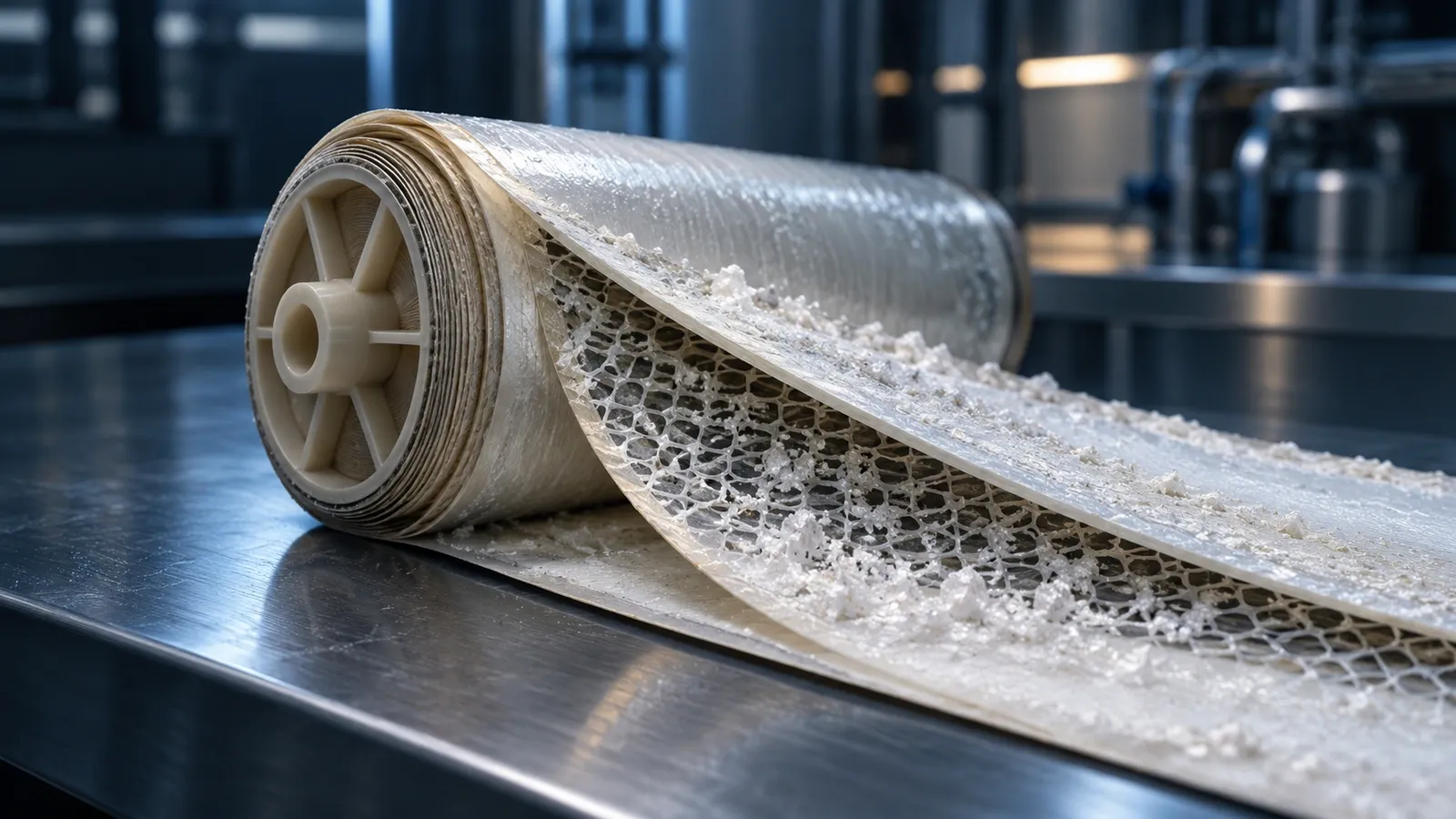
RO membrane scaling happens when sparingly soluble salts such as calcium carbonate, calcium sulfate or silica exceed their solubility in the concentrate and crystallize on the membrane surface. It shows first in the last stage as higher differential pressure, lower normalized flow and rising salt passage. Control combines feed water analysis, correct recovery and a suitable antiscalant, with acid or alkaline cleaning when deposits form.
How does scale form inside an RO system?
An RO membrane rejects dissolved salts, so the concentrate stream becomes progressively more concentrated along the pressure vessel. When the concentration of a sparingly soluble salt passes its saturation limit, crystals begin to nucleate and grow on the membrane and the feed spacer. The last elements of the last stage see the most concentrated water and are the first to scale.
Which salts cause scale most often?
Calcium carbonate is common where alkalinity and hardness are high. Calcium sulfate, barium and strontium sulfate, and silica are frequent in brackish and well waters. Metal hydroxides from iron and aluminium also deposit and can seed other scales.
Why is scale harder to deal with than other fouling?
Crystalline scale bonds to the membrane and grows with time. It restricts flow, increases pressure demand and can scratch or damage the membrane surface. Detecting it early, while the deposit is thin, makes cleaning effective and protects membrane life.
How is scaling prevented rather than removed?
Prevention starts at the design and operating stage. The recovery of the system is chosen from the feed analysis, an antiscalant suited to the actual scalants is fed continuously, and the feed pH is managed where needed. Monitoring the last stage, where scale appears first, gives an early warning that the programme needs adjustment.
Frequently asked questions
How often should RO membranes be cleaned?
There is no fixed calendar interval. Clean when normalized performance shows a clear change from the commissioning baseline: a rising differential pressure, falling normalized permeate flow or rising salt passage. Cleaning earlier, while the deposit is still thin, recovers performance more fully than waiting until the loss is severe.
What does an RO antiscalant do?
An antiscalant keeps sparingly soluble salts, such as carbonates and sulfates, in solution as the feed water is concentrated along the membrane train. It delays crystal growth and deposition on the membrane surface, so recovery can be run without scale forming in the concentrate stream.
How can antiscalant use be optimized?
Start from a current feed water analysis and the planned recovery, then set the treatment rate from the analysis and operating conditions rather than from habit. Confirm the choice by watching differential pressure and salt passage, and review it whenever the feed source, recovery or temperature changes.
Which cleaner suits scale and which suits biological or organic fouling?
Mineral scale is normally removed with an acidic cleaner, while biological and organic deposits respond to an alkaline cleaner. The right order depends on what the deposit is, so identify the foulant from the performance trend and a cleaning analysis first, and rinse thoroughly between the two steps.
How can fouling be told apart from normal changes in RO performance?
Normalize permeate flow, differential pressure and salt passage for feed temperature, pressure and recovery, then compare them with the start-up baseline. Raw readings move with the seasons and load. A steady drift in the normalized values, not a swing in the raw ones, points to fouling or scaling.
Symptoms
Scaling appears gradually and is concentrated in the final stage of the array. The usual signs:
- Differential pressure rises, most strongly across the last stage.
- Normalized permeate flow declines in the same period.
- Salt passage increases, because scale blocks areas of the membrane and raises local concentration at the surface.
- Cleaning solutions show cloudiness or dissolved metals, and an acid cleaning recovers performance noticeably.
- The loss of performance repeats soon after each cleaning when the underlying cause is not addressed.
Scale that is left in place tends to progress quickly once crystals provide surfaces for further growth.
A useful sign is that the last stage reacts first and the earlier stages follow only later. When the lead stages are still healthy but the final stage shows rising pressure loss, scale should be the first suspicion, and a feed analysis should be compared with the current recovery.
Cause
Scale forms when the concentrate exceeds the solubility of one or more salts. Several conditions push the system in that direction:
- Feed water that is naturally high in hardness, alkalinity, sulfate or silica.
- Operating at a recovery that concentrates the feed beyond what the water chemistry tolerates.
- Antiscalant that is unsuitable for the feed water, fed at a rate that does not match the analysis, or interrupted by pump or tank problems.
- Changes in feed water quality or temperature that are not reflected in the treatment programme.
- Metal ions from corroding pipework or carry-over from pre-treatment that act as nucleation sites.
Scaling is therefore a design and operating issue as much as a chemistry issue, and it is usually controlled by combining both.
Silica deserves special attention. It does not behave like carbonate and is not removed by acid cleaning, so it limits recovery on waters that contain it and calls for a specific antiscalant and a careful review of the operating margin.
Approach in steps
Diagnosis
The aim is to confirm which salt is scaling and where, then compare operation with what the water chemistry allows.
- Trend normalized flow, differential pressure and salt passage for each stage and look for a last-stage pattern.
- Obtain a complete feed water analysis, including calcium, magnesium, barium, strontium, sulfate, silica, alkalinity, iron and pH.
- Use the feed analysis and system recovery to estimate the saturation of the concentrate for each likely scalant.
- Check the antiscalant supply: product suitability, tank level, metering pump operation and feed point.
- Analyse a deposit sample, a cleaning solution or a membrane autopsy sample to identify the scale type directly.
Confirming the scale type avoids an unsuitable cleaning step, because an acid cleaner removes carbonate and metal oxides while sulfate and silica scales need different chemistry.
Keep records of antiscalant consumption against permeate output. A consumption pattern that differs from the plan shows a feed interruption or a metering fault long before the membranes show damage.
Treatment approach
Scale control works at two levels, prevention and removal.
- Antiscalant: a suitable RO antiscalant, fed continuously with a chemical metering pump, keeps sparingly soluble salts in solution as the concentrate gets stronger.
- Membrane cleaner: acid or alkaline membrane cleaning, selected for the scale type, removes deposits that have already formed and restores normalized performance.
- Operating review: recovery, feed pH adjustment and pre-treatment are reviewed against the water analysis.
- Monitoring: normalized data are trended so that the next cleaning is based on the trend and not on a sudden failure.
The treatment rate is set by our technical team from the water analysis and the operating conditions, and it is revised when the feed water changes.
After a cleaning, the cleaning solution is checked and the result recorded so that the next interval is based on evidence.
Send your operating data and a recent water analysis to our technical team for a technical review.
Related solutions
Programs
RO Chemicals: Antiscalants, Membrane Cleaners and Disinfectant
A treatment program for seawater and brackish RO plants: antiscalants to control scale, membrane cleaners to restore performance, and a disinfectant to limit biological growth.
Related products
Antiscalants
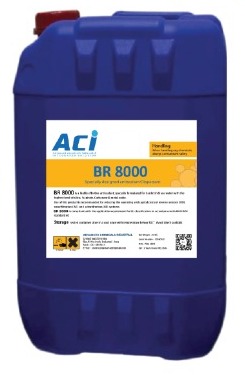
BR8000 Reverse Osmosis Antiscalant
Antiscalant for seawater and brackish water reverse osmosis, for controlling carbonate, sulphate, metal oxide and silica scale.
Let's discuss your water system.
Share the application and operating context to start a technical review.