
How to select an antiscalant for brackish-water RO
A practical decision path for choosing an RO antiscalant for brackish water: what the feed analysis must show, how recovery matters, and what to confirm before fitting a metering pump.
 Illustration
On this page (11)
Selecting an antiscalant for brackish-water RO starts with the feed water analysis, the planned recovery and the scaling salts most likely to reach saturation in the concentrate, usually carbonate, sulfate and silica. The antiscalant must also be compatible with the membrane and the other chemicals in the feed, and it needs reliable metering and monitoring to work.
Why does brackish water need an antiscalant at all?
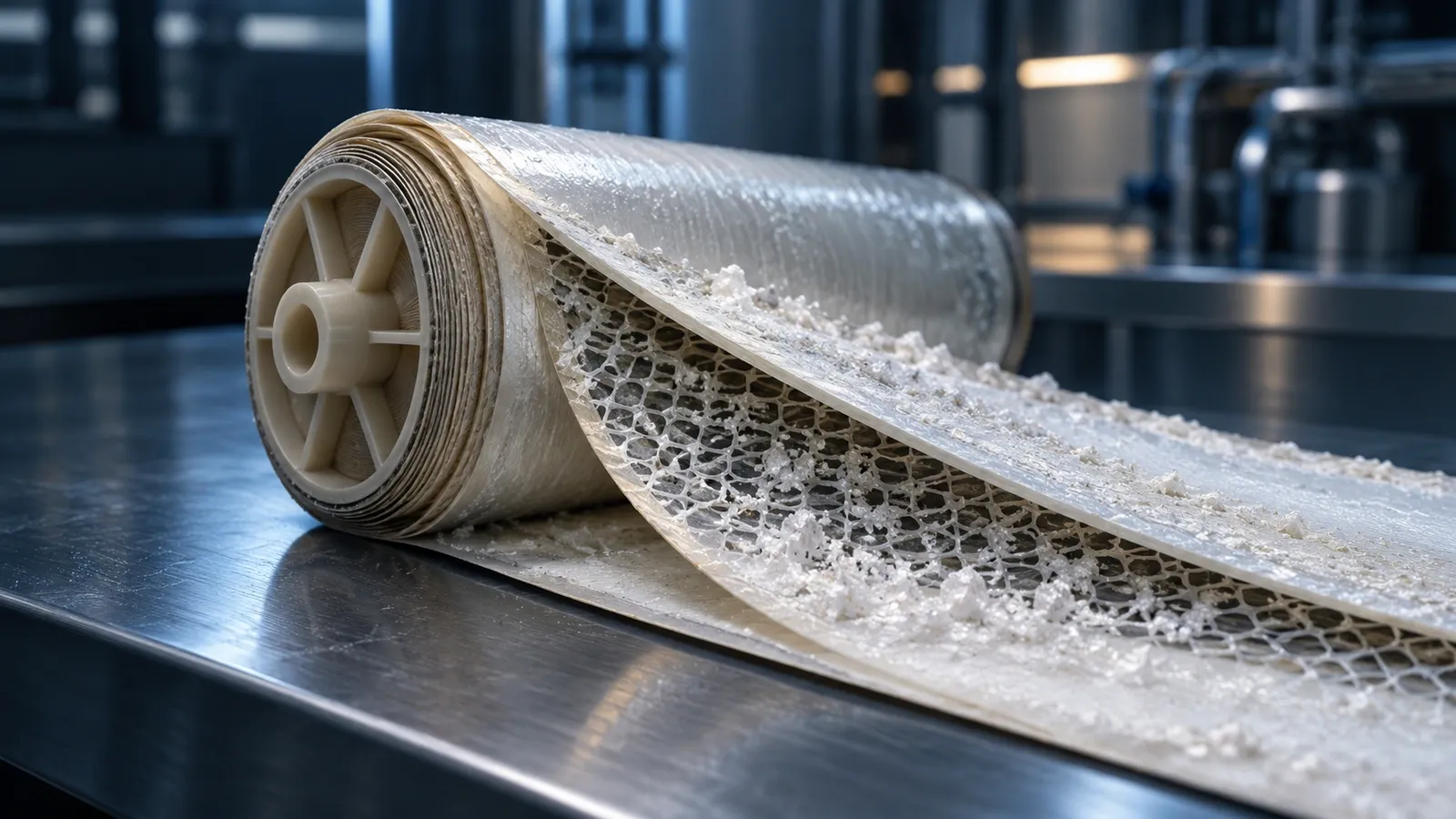
An RO membrane passes water and holds back salts, so the concentrate stream becomes steadily more concentrated as recovery rises. Brackish sources often carry hardness, alkalinity, sulfate and silica, and at the concentrate end of the array one or more of these can exceed solubility and crystallise on the membrane. An antiscalant interferes with crystal formation and growth so that the salts stay in solution, or form deposits that do not stick, until they leave in the concentrate.
What does the feed analysis need to show?
The analysis is the base of the choice. A complete one lets the technical team estimate which salts will limit the system, instead of treating all scale as the same.
- Hardness and alkalinity, which drive carbonate scaling together with pH.
- Sulfate together with calcium, barium and strontium, which drive sulfate scaling.
- Silica, which behaves differently from the salts and is not controlled by every antiscalant in the same way.
- Iron, manganese and aluminium, because metals can foul the membrane and interact with the antiscalant.
- Total dissolved solids, temperature and pH, as these shift the solubility of every salt.
- Organic indicators and microbiological information, which affect fouling rather than scaling but change the diagnosis.
How does recovery change the selection?
Recovery sets how concentrated the final stage becomes. A higher recovery pushes the concentrate closer to saturation, so the scaling limit tightens and the antiscalant has more to do. If recovery is changed after commissioning, for example to save water, the antiscalant choice and the rate of feed should be reviewed, because the original basis no longer applies.
Recovery is also a trade-off with the rest of the system. A lower recovery uses more feed water but reduces risk. A higher recovery saves water but narrows the margin and raises the cleaning frequency if control slips.
Which scale types should the antiscalant address?
- Carbonate scale: often managed by a combination of antiscalant and pH control, and generally the most common in brackish water.
- Sulfate scale: harder to remove once formed, so prevention carries more weight.
- Silica: needs specific attention because it is not removed by the usual acid clean and it limits recovery in many brackish sources.
- Metal-related fouling: calls for good pre-treatment first, since an antiscalant is not a substitute for removing iron.
Our datasheets list RO antiscalants as a product category for membrane systems. Which grade suits a given water is a matter for the analysis and the technical team, not for a general rule.
What compatibility checks come before purchase?
A good antiscalant on paper can still cause trouble if it meets the wrong chemical or the wrong membrane. Check these before it is fed.
- Membrane compatibility, confirmed against the membrane supplier guidance for the type installed.
- Compatibility with any coagulant, flocculant or cationic polymer in the pre-treatment, since some combinations form sticky deposits.
- Compatibility with the dechlorination chemical and with any acid used for pH control.
- Suitability for the end use of the permeate, if the water is used in a regulated or sensitive process.
What makes an antiscalant work or fail in operation?
Most antiscalant failures are failures of delivery or monitoring, not of chemistry.
- Metering: a chemical metering pump, correctly sized and primed, feeding at a steady rate that tracks flow.
- Mixing: injection upstream of the cartridge filter with enough mixing length, so the chemical is dispersed before it reaches the membrane.
- Storage: a clean day tank, protected from contamination and from running empty without an alarm.
- Monitoring: regular checks of the tank level, pump output and feed rate against the plan.
- Trending: stage-by-stage differential pressure and normalised salt passage, so that a developing scale problem is seen early.
Treatment rate is set from the water analysis and the operating conditions of the system, with monitoring and adjustment afterwards. Our technical team can discuss it against your data. We do not suggest a rate without that analysis.
When should the choice be reviewed?
- The feed source changes, or the borehole or supply analysis drifts over the seasons.
- Recovery, feed temperature or pH control is changed.
- Stage differential pressure or salt passage starts to climb with no pre-treatment fault.
- A new pre-treatment chemical is introduced upstream.
- The membranes are replaced with a different type.
What happens if the antiscalant feed is interrupted?
A short interruption can be enough for crystals to start forming at the concentrate end, especially at high recovery. Once crystals have nucleated they grow on their own and are harder to remove than to prevent. For this reason an alarm on the antiscalant tank and pump, and a routine look at the stage differential pressure, are as valuable as the choice of product.
How do I confirm the choice is working after start-up?
- Stage differential pressure stays close to the commissioning baseline.
- Normalised salt passage does not drift upwards in the last stage.
- Cleaning solutions from the last stage show no mineral scale when examined.
- The concentrate analysis, compared with the feed, matches the expected concentration without signs of salts dropping out.
What should I send for a technical review?
- A recent feed water analysis, ideally covering more than one sampling occasion.
- The design or current recovery, the number of stages and the membrane type.
- The pre-treatment layout and the chemicals fed upstream, including coagulant and dechlorination.
- The antiscalant currently used, how it is metered, and any scaling history or cleaning records.
- Normalised trend data since commissioning.
Next step
Send your operating data and a recent water analysis to our technical team for a technical review.
Sources
- Advanced Chemicals Industrial product datasheets, for the product categories and monitoring practice they state.
- General industrial water-treatment practice, described qualitatively.
Let's discuss your water system.
Share the application and operating context to start a technical review.