
RO Systems: Supply, Installation, Commissioning and Maintenance
Reverse osmosis systems supplied with installation, commissioning and maintenance, matched to the feed water and the water quality the process requires.
 Illustration
On this page (11)
Overview
An RO system turns a saline or hard feed water into water of a quality the process can use, and its performance depends as much on pretreatment, chemical treatment and operation as on the membranes themselves. Advanced Chemicals Industrial supplies RO systems and supports them through installation, commissioning and maintenance, with membrane chemicals available for the same plant.
What does an RO system consist of?
An RO plant is more than a membrane array. The main parts are:
- intake and feed storage, with screening or filtration of coarse solids
- pretreatment: media filtration, cartridge filtration, and chemical conditioning matched to the feed
- a high pressure pump and an energy recovery arrangement where the plant design calls for it
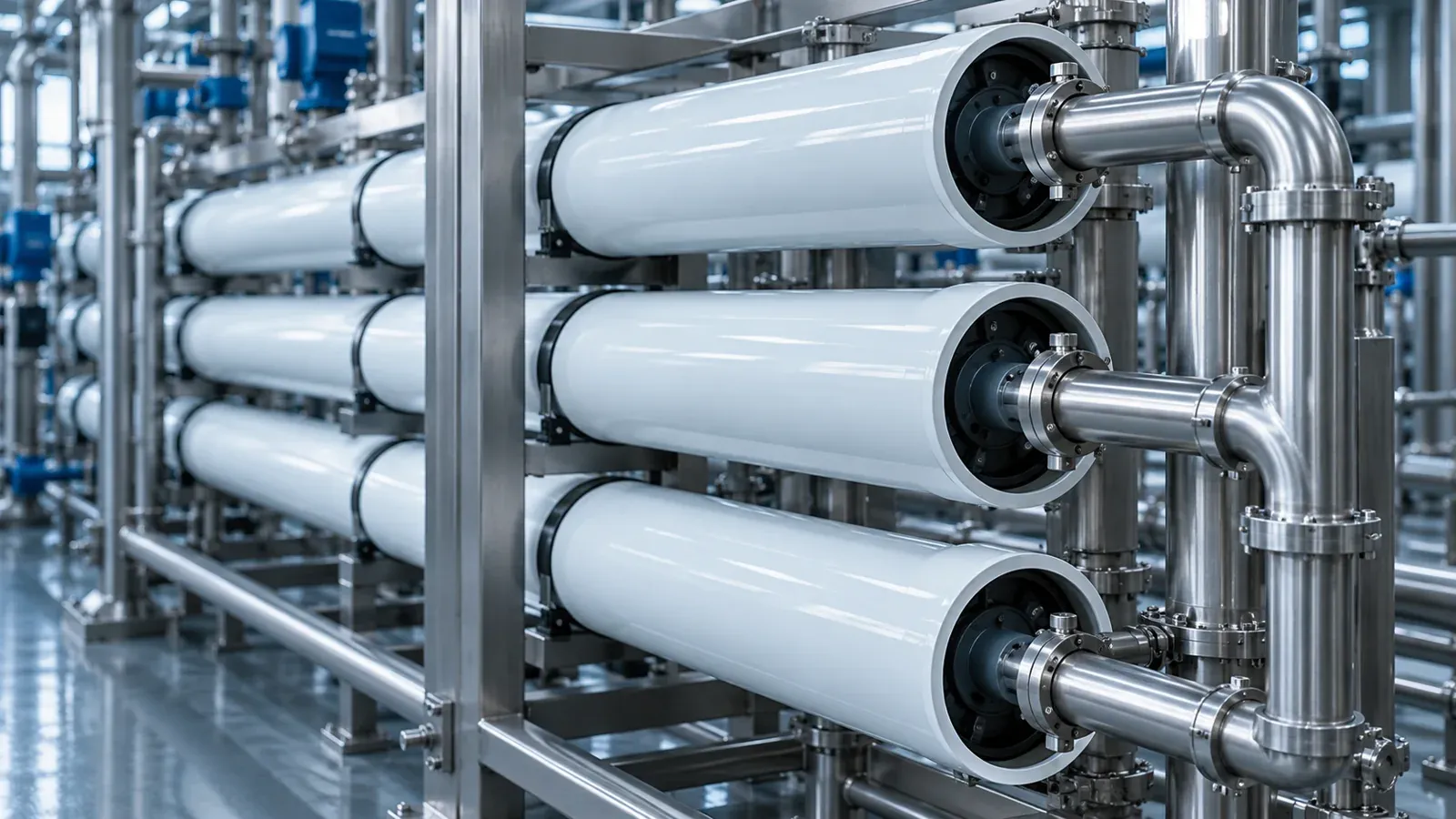
- pressure vessels and membranes arranged in stages
- a permeate side with storage, and where needed post-treatment such as pH correction
- instruments and controls for pressure, flow, conductivity and alarms
- a cleaning system and chemical feed systems
What capacity does the plant need?
Capacity is set from the process demand, the feed water quality and the recovery the feed can support without scaling. Sizing is confirmed per project from the feed analysis and the demand profile, not read off a table.
Which feed water information decides the design?
- a full water analysis covering salinity, hardness, alkalinity, silica, iron, manganese and organic content
- the temperature range through the year
- the source: seawater, brackish well, municipal supply or recycled water
- the permeate quality the process requires
- any seasonal change in the source
Salinity and temperature set the pressure and energy demand. Hardness, silica and sulfate set the achievable recovery and the antiscalant requirement. Suspended solids and organics set how much pretreatment is needed to protect the membranes.
Why does pretreatment matter so much?
Most premature membrane loss starts upstream. Suspended solids, iron and biological growth that pass through weak pretreatment foul the membrane, raise the differential pressure and shorten the interval between cleanings. A system designed with realistic pretreatment spends less on cleaning chemicals and downtime over its life.
How does the system stay in good condition after start-up?
Stable operation rests on routine. Pressures, flows and conductivity are recorded and normalized so that a drift can be seen early. Antiscalant feed is checked, cartridge filters are changed when their differential pressure rises, and membranes are cleaned when the data call for it. Without this routine a well designed plant still loses performance.
Two typical early signals are worth watching:
- a rising differential pressure, which points to fouling or scaling in the feed path
- a rising salt passage, which points to a change at the membrane surface or a leak
How do installation and commissioning fit in?
Installation places and connects the equipment to the building services. Commissioning verifies that it works as designed and records the baseline that every later performance check will be compared with. A missing or careless baseline makes later troubleshooting much harder.
The detail of how these phases are carried out is described on the installation and commissioning page. Supply terms, lead times and the extent of support for each project are confirmed with the company for the specific system.
What should a buyer compare between proposals?
- the design basis: the feed analysis, temperature and recovery assumed
- the pretreatment included, and what it leaves out
- the membrane type and the number of stages
- instrumentation that allows normalized monitoring
- access for cleaning and for membrane replacement
- the chemical program the design expects, and its running cost
A lower purchase price with weak pretreatment or no monitoring often costs more over the first membrane life. Ask which assumptions the design depends on and what happens if the feed changes.
What about future change?
Feed quality, demand and regulations can change. A plant sized with room for another stage, or with spare connections for chemical feed and instruments, adapts at lower cost than one built tight to the demand of the day.
Send the feed water analysis, the water quality and quantity the process needs, the site conditions, and any existing equipment to our technical team. They review the information and respond on the technical basis of a suitable system.
Applications
RO systems serve any operation that needs water of better quality than its source provides. Common settings are industrial process water, boiler makeup preparation, cooling system makeup where salinity limits the cycles of concentration, desalination of seawater or brackish well water, and water for hotels, hospitals and commercial buildings.
Industrial process water
Industrial plants and food and beverage sites use RO permeate where a stable, low-salinity supply protects the product or the equipment.
Boiler makeup
Lower dissolved solids in makeup water reduce blowdown and the load on boiler treatment chemicals.
Desalination
Brackish wells and seawater are treated at a scale that matches the demand, with pretreatment designed around the intake.
Commercial and institutional buildings
Facility teams use RO for sensitive equipment, kitchens and utilities where scale in the supply causes recurring faults.
Projects led by consultants and contractors
MEP consultants and contractors specify RO as part of a larger utility package, and need a clear technical basis from the supplier for the design, the pretreatment and the interfaces with other services.
Each application is confirmed against the feed analysis and the demand before a system is proposed.
Problems this addresses
Problems
Why is RO differential pressure increasing?
A rising differential pressure across an RO system points to restricted feed channels. Learn how to tell fouling, scaling and pre-treatment problems apart before cleaning.
Problems
What causes RO membrane scaling and how is it controlled?
RO membrane scaling is the crystallisation of sparingly soluble salts on the membrane as the concentrate becomes saturated. See the signs, causes, checks and the treatment approach.
Let's discuss your water system.
Share the application and operating context to start a technical review.