
The main causes of RO membrane fouling
The main causes of RO membrane fouling, how each shows up in plant data, and the checks that separate scale, particles, organics and biological growth.
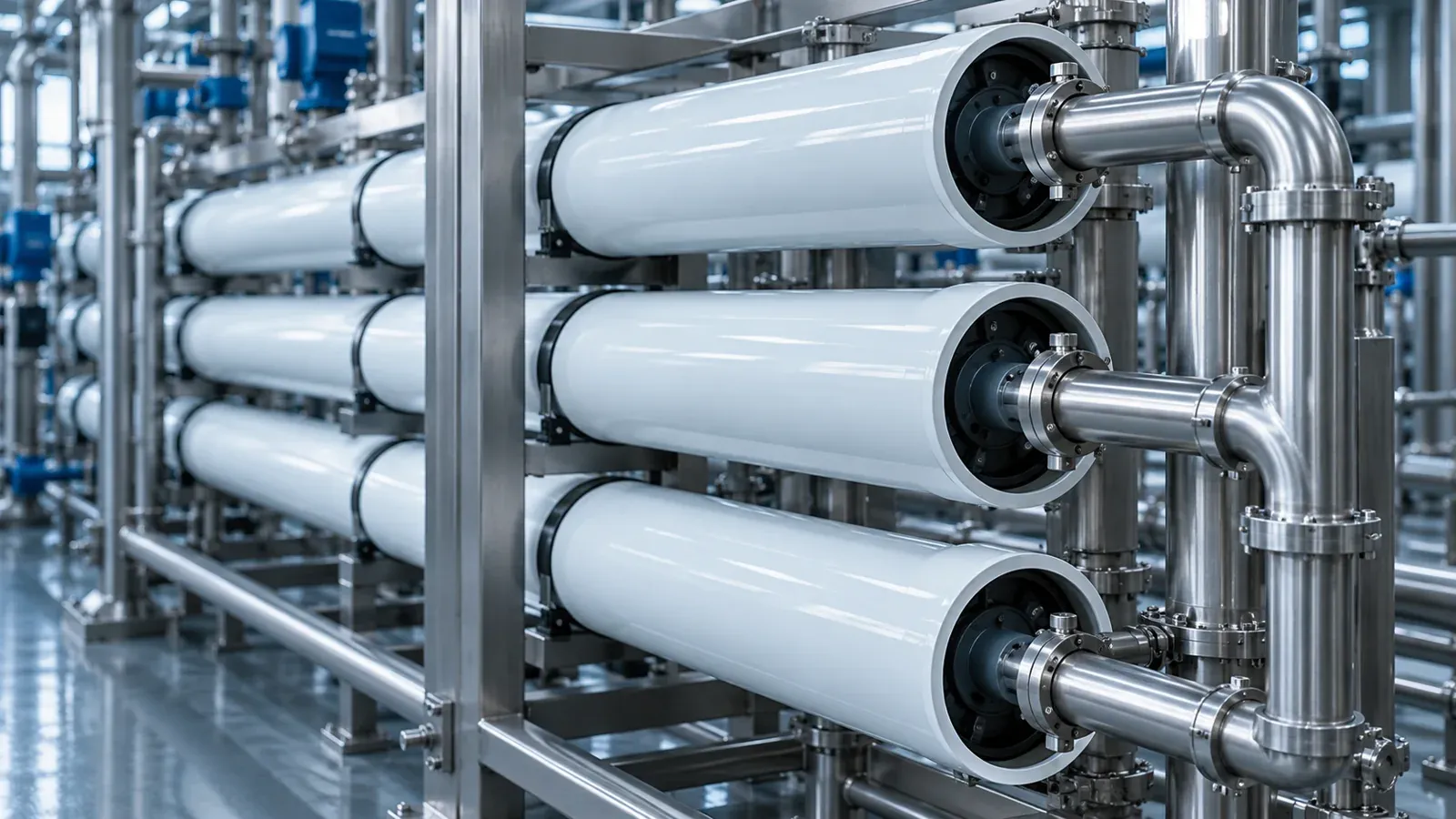 Illustration
On this page (12)
RO membrane fouling has a small number of root causes: mineral scale, suspended particles and colloids, organic matter, biological growth, and chemical damage or contamination from pre-treatment. They often overlap, so the first job is to read the symptoms by stage and compare them with the feed analysis before choosing any cleaning or prevention step.
What is fouling, and how is it different from scaling?
Fouling is the build-up of unwanted material on the membrane surface or in the feed channel. Scaling is one kind of fouling, where dissolved salts exceed their solubility as the water is concentrated and crystallise out. The other kinds come from material that is already in the feed or grows in the system.
Cause one: mineral scale
Sparingly soluble salts, such as carbonate, sulfate and silica, become more concentrated along the array. Scale usually starts at the concentrate end, where the water is most saturated, and it often raises salt passage and differential pressure in the last stage first.
- Typical trigger: high recovery, hard or silica-rich feed, or an interruption in antiscalant feed.
- Typical evidence: last-stage differential pressure rising, and a feed analysis showing a high scaling tendency.
- Prevention: antiscalant matched to the water, control of recovery and pH, and reliable metering.
Cause two: suspended particles and colloids
Silt, clay, corrosion products and colloids carried over from filtration collect at the membrane inlet and in the feed spacer. Iron and aluminium from coagulation are frequent contributors, and so are fine particles from a media filter that has channelled.
- Typical trigger: poor filtration, a coagulant that is over-fed or poorly settled, or an upstream disturbance.
- Typical evidence: first-stage differential pressure rising, and cartridge filters that foul quickly with a coloured deposit.
- Prevention: better pre-filtration, controlled coagulant feed, and a regular review of the filter condition.
Cause three: organic matter
Natural organic matter, oils and incompatible polymers can coat the membrane and lower permeate flow. They also feed biological growth by giving bacteria something to live on, so organic and biological fouling are often found together.
- Typical trigger: surface or reclaimed water sources, oil carry-over, or a pre-treatment polymer that does not suit the membrane.
- Typical evidence: gradual flow loss with a coloured or greasy cleaning solution.
- Prevention: pre-treatment that removes organics, and care in selecting any chemical that reaches the membrane.
Cause four: biological growth
Bacteria attach to the membrane and the spacer and form a slime layer. Once it has formed it is hard to remove, because the film protects the organisms and traps more particles. Biofilm is a frequent cause of high differential pressure in the first stage and of repeated cleanings.
- Typical trigger: warm feed, nutrients in the feed, stagnation during shutdowns, and unprotected storage tanks or lines.
- Typical evidence: first-stage differential pressure rising steadily, slime on cartridge filters, and microbiological counts that increase.
- Prevention: good hygiene in the pre-treatment, controlled shutdown practice, and a membrane-compatible disinfectant where it suits the system.
Cause five: chemical damage and contamination
Oxidants such as chlorine that reach a polyamide membrane damage its surface and raise salt passage permanently. Incompatible chemicals can also form sticky deposits when they meet in the feed, for example a cationic polymer meeting an anionic antiscalant.
- Typical trigger: a failed dechlorination step, or a change of chemical in the pre-treatment without a compatibility check.
- Typical evidence: rising salt passage without a matching rise in differential pressure, or an unexplained gel-like deposit.
- Prevention: a monitored dechlorination step, and a compatibility review before any new chemical is introduced.
How do I tell the causes apart in plant data?
Use the location of the pressure loss, the trend of salt passage and the character of the cleaning solution together.
- First-stage differential pressure rising points to particles, organics or biological growth.
- Last-stage differential pressure and salt passage rising points to scale.
- Salt passage rising alone points to chemical damage, an oxidant leak or a mechanical fault.
- A slimy deposit and rising counts point to biological growth, and a metallic colour points to iron or aluminium.
A foulant analysis from a cleaning sample or a membrane autopsy is the most direct confirmation, and it is worth doing when the same problem keeps returning.
Which cleaner and which preventive step fits each cause?
Mineral scale and metal oxides respond to an acid clean, while organic and biological deposits respond to an alkaline clean. Prevention is different for each cause: antiscalant for scale, improved filtration for particles, organics removal and hygiene for biological growth, and process control for chemical damage.
Our datasheets list RO antiscalants, membrane cleaners and a disinfectant as separate product categories. Selection and treatment rates are set by our technical team from the water analysis and operating conditions, not from the symptom alone.
How do the causes make each other worse?
Fouling rarely arrives alone. A biofilm traps particles and creates a protected zone where scale crystals grow more easily. Particles settle in the feed channel and give bacteria a surface. A small antiscalant interruption lets scale start, and the rough crystals then catch more particles. This is why a single corrective clean often disappoints: it removes one layer while the conditions that built the other layers remain.
What habits protect a membrane from all of these causes?
- Keep a baseline of normalised data from commissioning and trend it by stage.
- Analyse the feed water at a regular interval, not only at design stage, and after any change of source.
- Keep the pre-treatment in good order: filters backwashed on need, cartridge filters changed on trend, dechlorination monitored.
- Feed the antiscalant reliably and check the tank, pump and injection point routinely.
- Avoid long periods of standing water, and protect the membranes during shutdowns.
- Review every new chemical for compatibility before it reaches the feed.
What should I send for a technical review?
- A recent feed water analysis, including hardness, alkalinity, silica, iron and organic indicators.
- Normalised trend data for permeate flow, salt passage and differential pressure by stage.
- The pre-treatment configuration and the chemicals currently fed.
- The cleaning history, including what each cleaning solution looked like and how the plant responded.
- Any shutdown or storage practice that could leave water standing in the system.
Next step
Send your operating data and a recent water analysis to our technical team for a technical review.
Sources
- Advanced Chemicals Industrial product datasheets, for the product categories and monitoring practice they state.
- General industrial water-treatment practice, described qualitatively.
Let's discuss your water system.
Share the application and operating context to start a technical review.