
Biological fouling in cooling systems: causes and control
What causes biological fouling in cooling systems, how it damages heat transfer and metal, and how oxidising and non-oxidising biocides differ in general terms.
 Illustration
On this page (11)
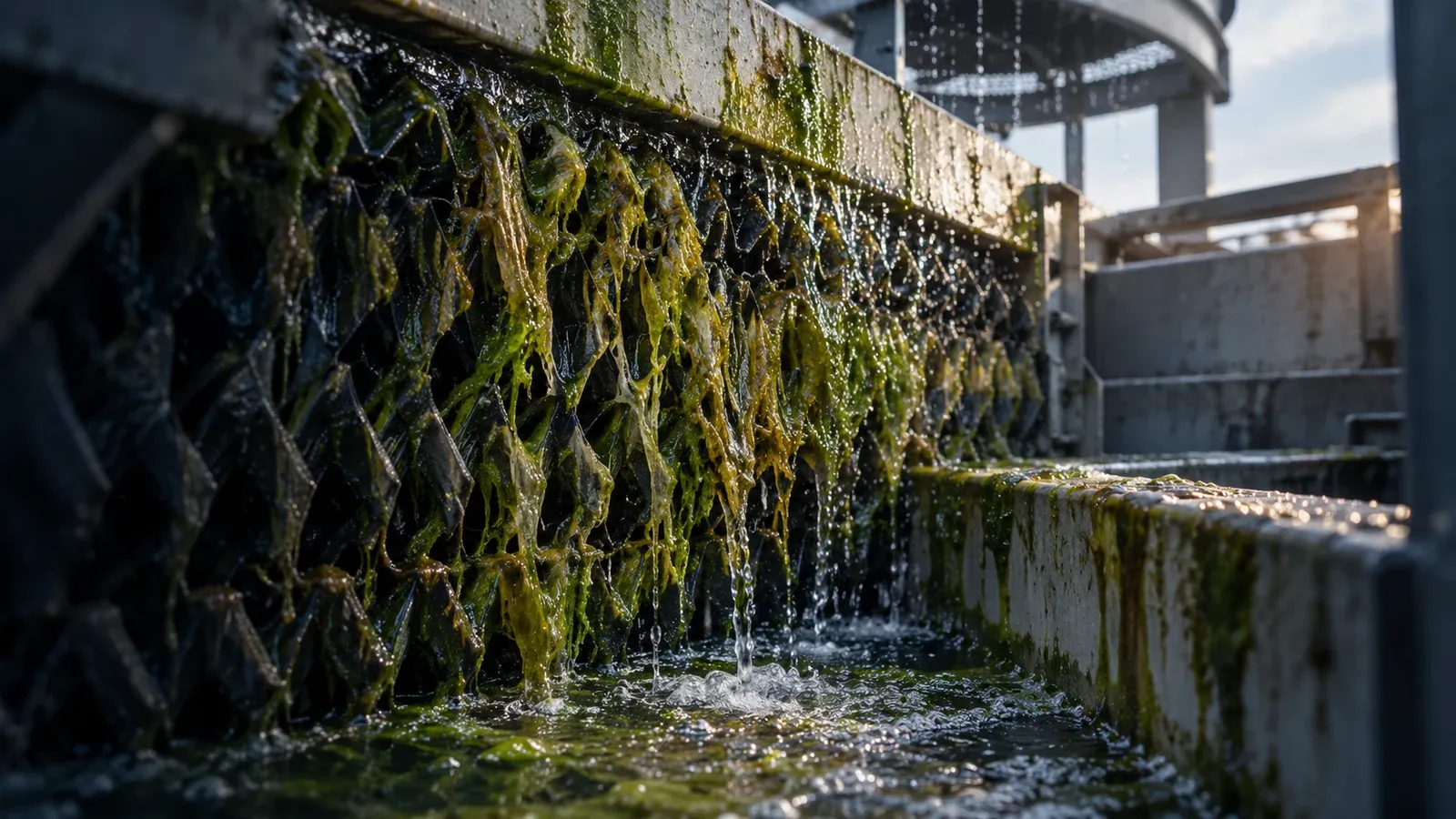
Biological fouling in cooling systems comes from bacteria, algae and fungi that find warmth, nutrients and surfaces to colonise, then build a slimy biofilm. It reduces heat transfer, shelters corrosion and can carry health risk. Control combines clean make-up and good design, regular microbiological monitoring, and a biocide programme matched to the system.
What causes biological growth in a cooling system?
Cooling circuits give microorganisms nearly everything they need. Warm water, dissolved oxygen, light in open basins and a steady supply of nutrients from the air and the make-up water all favour growth.
- Warm temperatures in the circulating water, especially across the condenser.
- Nutrients from airborne dust, organic contamination, leaks from process streams and the make-up water itself.
- Sunlight on open basins and fill, which supports algae.
- Low-flow zones, dead legs and standby equipment where water stagnates.
- Deposits, scale and corrosion products, which give organisms a protected surface.
- Poor control of concentration, so that the water carries more nutrients than planned.
Why is biofilm such a problem?
A biofilm is a layer of cells embedded in a slimy matrix. The matrix traps particles and shelters the organisms from treatment chemicals, so a film is much harder to remove than free-floating bacteria are to control. Biofilm brings several operating costs together.
- Insulation of heat-transfer surfaces, which lifts approach temperature and energy use.
- Under-deposit and microbiologically influenced corrosion on metal.
- Restricted flow, blocked fill and fouled strainers.
- Reduced effectiveness of the scale and corrosion inhibitor under the deposit.
- Potential health risk from organisms in the water and in drift, which is why local rules and good practice apply.
How do I spot biological fouling early?
- Slime on fill, basin walls, strainers and exchanger surfaces.
- Slimy or cloudy water, odour, and algae in open basins.
- Rising microbiological counts in routine tests.
- A creeping loss of heat-transfer performance without scale evidence.
- Biocide demand that rises, shown by a falling residual.
What is the difference between oxidising and non-oxidising biocides?
The two groups work differently and are often used together in a planned programme.
Oxidising biocides
Oxidising biocides, such as chlorine or bromine-based products, attack cells by oxidation. They act quickly and are widely used for routine control. Their effect depends on pH and on the demand in the water, they can be consumed by organics and corrosion products, and they can be harsh on some materials.
Non-oxidising biocides
Non-oxidising biocides act on specific cell functions instead. They tend to persist longer, are less affected by pH, and are often alternated with an oxidising product so that organisms do not adapt to one chemistry.
Our datasheets list two non-oxidising types for cooling systems: an isothiazolinone (CMIT/MIT) biocide and a DBNPA-based biocide. The isothiazolinone type is valued for broad activity, while DBNPA acts quickly and breaks down fairly fast in the system. Choice depends on the water, the system and the discharge conditions.
How does a good biocide programme work?
- Alternating chemistries, so the population does not adapt to one product.
- Feeding by a chemical metering pump on a schedule and with a method suited to the system, with a record of when and how much, kept by the technical team.
- Using a biodispersant or cleaning step when a film is already established, since a biocide alone does not remove it.
- Checking compatibility with the scale and corrosion inhibitor, and with the materials in the circuit.
- Respecting the safety and discharge conditions that apply to the site and the product.
Treatment rate is set from the water analysis and operating conditions, and monitored through microbiological testing. Our technical team can discuss it against your data.
What should be monitored?
- Microbiological counts by dip slide or laboratory test, at a regular interval.
- Biocide residual or demand, where the product allows it.
- pH, conductivity and make-up quality, as they shape both growth and biocide performance.
- Visual inspection of basin, fill and strainers.
- Approach temperature and heat-transfer performance as indirect indicators.
How do design and housekeeping reduce growth?
- Keep basins clean and covered from sunlight where possible.
- Remove dead legs, or flush them regularly.
- Keep standby equipment treated or drained, not stagnant.
- Keep drift eliminators in good order.
- Clean the system thoroughly after a heavy contamination event or a long shutdown.
How should a biological upset be handled?
When counts rise or slime appears suddenly, the first step is to find out why, not only to add more biocide. Check for a new nutrient source such as a process leak, a change in make-up water, a period of low flow, a lapse in the biocide feed, or a loss of residual. Then restore control with the programme adjusted to the cause, and add a cleaning or dispersing step if a film has formed.
- Confirm the biocide feed is running and the chemical is available.
- Review the last microbiological results and the residual records.
- Check for process leaks into the circuit, since they bring nutrients.
- Inspect the basin, fill and any stagnant areas.
- Retest after treatment, and keep a record of the response.
What safety points apply to biological control?
Biocides are hazardous chemicals. Follow the safety data for each product, use suitable protective equipment, store and handle them as the site rules require, and keep the discharge conditions in mind. Because cooling systems can also carry health risk from organisms in the water, the site should have a water management plan that fits local rules and good practice, and the technical team can discuss the chemical side of it.
What should I send for a technical review?
- Microbiological test results and the dates and methods used.
- The biocide currently fed, how and when it is fed, and any residual readings.
- A recent make-up and circulating water analysis.
- A description of the system, including basin type, shutdown pattern and any dead legs.
- Photographs or notes on slime, odour or algae and any related corrosion.
Next step
Send your operating data and a recent water analysis to our technical team for a technical review.
Sources
- Advanced Chemicals Industrial product datasheets, for the product categories and monitoring practice they state.
- General industrial water-treatment practice, described qualitatively.
Let's discuss your water system.
Share the application and operating context to start a technical review.