
Product code: BR8000
Reverse Osmosis Antiscalant
Antiscalant for seawater and brackish water reverse osmosis, for controlling carbonate, sulphate, metal oxide and silica scale.
Overview
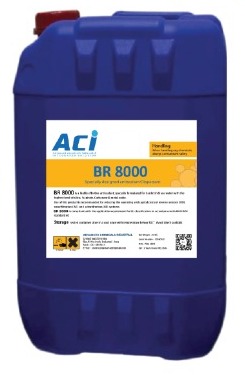
BR8000 is a reverse osmosis antiscalant for seawater and brackish water systems. It is used to control the formation of carbonate, sulphate, metal oxide and silica scale on the membrane surface.
Its chelation and dispersion effects and its calcium tolerance are the properties the product flyer highlights. It can be diluted with RO permeate or distilled water before it is fed.
The treatment rate and the operating instructions are set for each system by our technical team. For technical data, a treatment recommendation for your system or a product sample, contact our technical team with a recent water analysis and your operating data.
Problems this addresses
Related solutions
Key features
- Chelation and dispersion effects
- Calcium tolerance
- Compatible with major RO membranes
- Suitable for RO and NF membranes
- Helps protect membrane life
- Can replace acid addition in suitable systems
Applications
Seawater and brackish water reverse osmosis.
Reverse osmosis (RO) and nanofiltration (NF) membranes.
Scale types addressed, as listed in the flyer: calcium carbonate and calcium sulphate, calcium phosphate, barium and strontium sulphate, silica, iron and manganese.
Technical data
Specifications
- Form
- Aqueous liquid
- Colour
- Yellowish to orange
- pH (concentrate)
- below 5
- Solubility in water
- Completely soluble
Product data sheet
A printable A4 sheet of this product, from the same approved record as this page.
Questions about this product
What does an RO antiscalant do?
An antiscalant keeps sparingly soluble salts, such as carbonates and sulfates, in solution as the feed water is concentrated along the membrane train. It delays crystal growth and deposition on the membrane surface, so recovery can be run without scale forming in the concentrate stream.
How can antiscalant use be optimized?
Start from a current feed water analysis and the planned recovery, then set the treatment rate from the analysis and operating conditions rather than from habit. Confirm the choice by watching differential pressure and salt passage, and review it whenever the feed source, recovery or temperature changes.
Let's discuss your water system.
Share the application and operating context to start a technical review.