
Industries
Municipal
Municipal water supply, desalination and sewage treatment depend on steady membrane and chemical processes. This page outlines the typical systems, problems and decision points.
On this page (6)
Overview
Municipal water services cover drinking-water supply, desalination and the collection and treatment of sewage. They run continuously, serve the public and are judged on steady service. This page gives a general overview of the water systems and problems typical of the sector. It is not a statement of past work in the sector.
Which water systems are typical in municipal service?
Brackish and sea water RO plants produce drinking or service water from saline sources. Treatment stages ahead of the membranes remove suspended matter and control biological growth. Sewage treatment plants use screening, biological treatment, clarification and sludge handling, often with coagulants, flocculants and pH control. Municipal buildings and district facilities also run chilled-water loops and cooling towers.
What typically goes wrong?
- Scaling of RO membranes by sparingly soluble salts when recovery or antiscalant control is not matched to the feed water.
- Biofouling of membranes and pretreatment, seen as a rising differential pressure.
- Changes in feed water quality with season or source, which move the treatment balance.
- Poor floc formation and settling in sewage treatment when chemical selection or mixing is not right.
- Odour, foam and sludge handling difficulties at treatment works.
What do decision makers in the sector care about?
Plant operators and public-sector managers care about continuity of service, predictable operating cost per unit of water treated, and the ability to explain and document operations to oversight bodies. They look for treatment programs that remain stable as feed water changes, clear maintenance routines for membranes, and suppliers who can state technical facts plainly. Tender-style procurement places weight on clear technical documentation.
How does a problem-led approach help?
Public services benefit from diagnosis before intervention. A climbing differential pressure, a falling permeate output or a poor settling result each has a testable cause. Our technical team reviews the water analysis and the operating data, sets treatment rates for the conditions, and recommends the monitoring that lets operators see a change before it becomes an outage.
Challenges
These challenges are typical of the sector in general and do not describe our own experience in it.
- Feed water that changes with season, rainfall and source, so a fixed treatment recipe drifts.
- Large membrane areas, where cleaning decisions carry real cost and downtime.
- Public accountability, which makes record keeping and clear technical reasoning essential.
- Sewage composition that varies by hour and by day, which affects chemical control.
- Long asset life, with equipment of different ages operating side by side.
- Budget processes that reward lifecycle thinking but require clear technical justification.
Sending operating data and a recent water analysis to our technical team is a practical way to begin a technical review.
Related solutions
RO Chemicals: Antiscalants, Membrane Cleaners and Disinfectant
A treatment program for seawater and brackish RO plants: antiscalants to control scale, membrane cleaners to restore performance, and a disinfectant to limit biological growth.
RO Systems: Supply, Installation, Commissioning and Maintenance
Reverse osmosis systems supplied with installation, commissioning and maintenance, matched to the feed water and the water quality the process requires.
Wastewater and STP Chemicals: Coagulation, Flocculation and pH Adjustment
Chemical treatment steps for sewage treatment plants and industrial wastewater: coagulation, flocculation, pH adjustment, defoaming and clarification.
RO System Maintenance
What maintenance of an RO system involves: monitoring normalized data, deciding when to clean, replacing consumables and keeping the chemical supply continuous.
Water Analysis Request
How to send a water analysis, the system type, the capacity and the current problem to our technical team so your case can be reviewed.
Related applications
Brackish Water RO
Brackish water RO removes dissolved salts from water of moderate salinity. Scaling, fouling and biofouling of the membranes are the main risks, and they show up first as differential pressure and output.
Seawater RO
Seawater RO produces fresh water from sea water through high-pressure membranes. High salinity, marine biology and scaling tendency make pretreatment and antiscalant control central.
Related products
Antiscalants
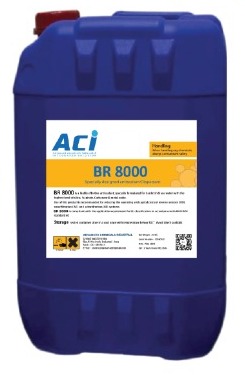
BR8000 Reverse Osmosis Antiscalant
Antiscalant for seawater and brackish water reverse osmosis, for controlling carbonate, sulphate, metal oxide and silica scale.
Related problems
What causes RO membrane scaling and how is it controlled?
RO membrane scaling is the crystallisation of sparingly soluble salts on the membrane as the concentrate becomes saturated. See the signs, causes, checks and the treatment approach.
What is RO membrane biofouling and how do you control it?
Biofouling is the growth of a bacterial biofilm on RO membranes and feed spacers. Learn the signs, causes, checks and the cleaning and disinfection approach.
Why is RO differential pressure increasing?
A rising differential pressure across an RO system points to restricted feed channels. Learn how to tell fouling, scaling and pre-treatment problems apart before cleaning.
Let's discuss your water system.
Share the application and operating context to start a technical review.