
Cooling tower scale vs corrosion: how to tell them apart and treat both
Scale and corrosion pull cooling water treatment in opposite directions. Learn how to recognise each, why one fix can worsen the other, and what to monitor.
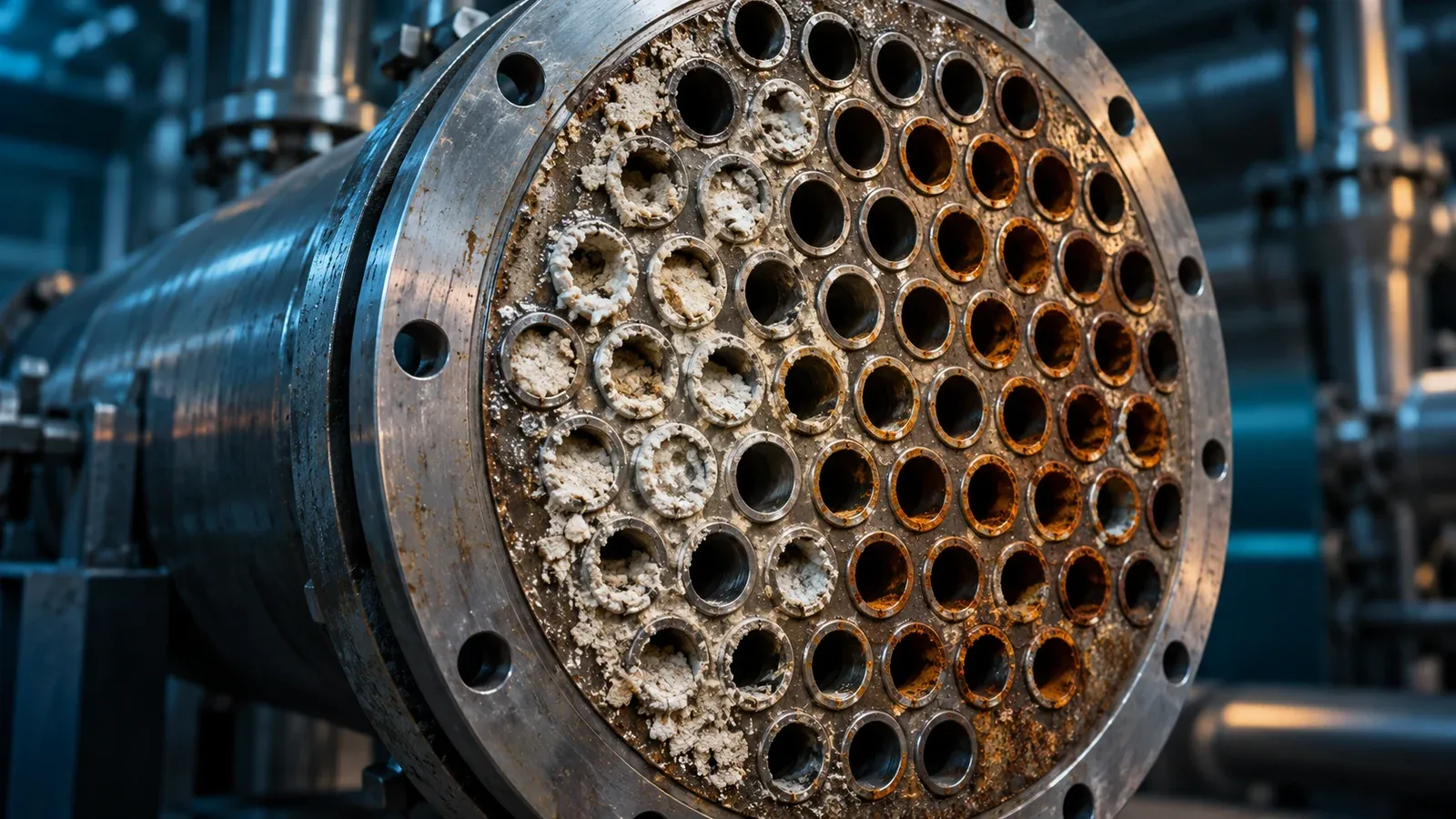 Illustration
On this page (12)
Scale and corrosion are opposite risks in a cooling tower: scale forms when the water is too concentrated or alkaline, corrosion when it is too aggressive or too low in protection. Treatment has to balance both by controlling concentration, pH and conductivity, and by feeding an inhibitor that protects metal and holds hardness in solution.
What is the difference between scale and corrosion?
Scale is a hard mineral deposit, usually calcium carbonate or calcium sulfate, that crystallises on warm heat-transfer surfaces. It insulates the metal and reduces heat transfer. Corrosion is the loss of metal into the water, caused by dissolved oxygen, aggressive ions, low pH or deposits that set up local cells. It thins and pits pipes, exchangers and fill supports.
Both reduce efficiency and shorten equipment life, but they respond to opposite water conditions, which is why they are treated together.
Why can fixing one make the other worse?
An open recirculating tower evaporates water, so dissolved solids build up in the circuit until they are removed by blowdown. Holding concentration low controls scale but raises water use. Pushing concentration up saves water but raises both scaling tendency and the aggressiveness of the chloride and sulfate that attack metal.
Acid feed to lower pH reduces carbonate scale, but a pH that is too low speeds up corrosion. The same trade-off applies to high alkalinity. The aim is a controlled operating window rather than the extreme in either direction.
How does scale show up in practice?
- Rising approach temperature on the tower and a warmer return from the chillers or process exchangers.
- White or tan crusts on fill, basin, nozzles and exchanger tubes.
- Falling flow or rising pump pressure as pipes and strainers restrict.
- Higher energy use at the chiller because condenser heat transfer has worsened.
How does corrosion show up in practice?
- Red or brown water, rust deposits and pitting on carbon steel.
- Leaks at exchanger tubes, welded joints and small-bore pipework.
- Corrosion coupons or probes showing metal loss over time.
- Iron and copper rising in routine water tests.
Corrosion products can also settle as deposits, which protect bacteria and create under-deposit attack, so corrosion and microbiological problems often travel together.
What should be monitored to keep both under control?
Our datasheets state that treatment rates are set from the water analysis and the operating conditions, with monitoring of pH, conductivity and corrosion indicators. A practical routine covers the following.
- Conductivity of the circulating water against the make-up water, as the working measure of concentration and the trigger for blowdown.
- pH, alkalinity and hardness, which set the scaling tendency.
- Chloride and sulfate, which influence how aggressive the water is.
- Inhibitor residual, for example the zinc residual when a zinc-based inhibitor is used.
- Corrosion coupons or probes, read at regular intervals, and a visual look at basin, fill and heat exchangers during shutdowns.
- Microbiological monitoring, since biological growth feeds both deposits and corrosion.
Which chemicals deal with scale and corrosion together?
Cooling tower inhibitors are designed as a combined programme. The company supplies a zinc-based scale and corrosion inhibitor for open recirculating cooling towers, listed in its datasheets. The corrosion part forms a protective film on metal, and the scale part stops hardness salts from crystallising or keeps them dispersed so they leave with blowdown.
Zinc-based programmes depend on pH and on holding the residual in the range stated for the product, so they need regular testing. A biocide programme runs alongside, because slime and deposit control protects the inhibitor film.
How should blowdown and make-up be managed?
Blowdown is the main lever for controlling concentration. Setting it from conductivity, rather than by a fixed habit, keeps scaling tendency and corrosivity inside the planned window. If make-up water quality changes, for example when the source or its softening changes, the window moves and the programme needs a review.
- Automatic blowdown linked to conductivity, where the site allows it.
- Make-up water analysis repeated when the source or pre-treatment changes.
- A written operating window for conductivity, pH and inhibitor residual, agreed with the technical team.
What should I look at during a shutdown?
- Heat exchanger tube bundles for scale, deposits or pitting.
- Basin floor and corners for sludge, which can hide corrosion and bacteria.
- Fill, drift eliminators and nozzles for scale and biological growth.
- The blowdown and chemical feed connections, for blockages or leaks in the chemical feed lines.
How do changes in make-up water shift the balance?
Make-up water sets the starting point for everything in the circuit. A source with more hardness or alkalinity raises scaling tendency at the same concentration, and a source with more chloride raises corrosivity. Seasonal changes, a switch between sources, or a change in softening all move the window, so the make-up analysis should be repeated and the programme reviewed after such a change.
What is a sensible response to early warning signs?
- A rising approach temperature: check conductivity, blowdown and the condition of the fill before assuming scale.
- Rust-coloured water: check the inhibitor residual, pH and make-up before increasing blowdown.
- Deposits found at shutdown: collect a sample for analysis so the cause can be identified.
- Repeated leaks in one area: look for local conditions such as low flow, deposits or dissimilar metals.
What should I send for a technical review?
- A recent make-up water analysis and a circulating water analysis.
- The operating conductivity or concentration, blowdown method and the current treatment.
- Pictures or descriptions of any deposits, pitting or leaks, and corrosion coupon results if they exist.
- The materials in the circuit, such as carbon steel, copper alloys or stainless steel.
- The cooling duty and any recent changes to load, make-up source or biocide use.
Next step
Send your operating data and a recent water analysis to our technical team for a technical review.
Sources
- Advanced Chemicals Industrial product datasheets, for the product categories and monitoring practice they state.
- General industrial water-treatment practice, described qualitatively.
Let's discuss your water system.
Share the application and operating context to start a technical review.