
When should an RO membrane be chemically cleaned?
How to tell from normalised performance trends, not from the calendar, that an RO membrane needs a chemical clean, and what to check first.
 Illustration
On this page (10)
An RO membrane should be chemically cleaned when normalised performance has clearly moved away from its baseline: permeate flow has fallen, salt passage has risen, or differential pressure across a stage has climbed, after the feed conditions are ruled out. Clean early on a confirmed trend rather than on a fixed date, and choose the cleaner from the deposit, not from habit.
Which signals say a clean is due?
Three trends, read together, carry most of the information. Reading any one alone can mislead, because temperature, feed salinity and recovery all move the raw numbers.
- Normalised permeate flow drifting down from the commissioning baseline.
- Normalised salt passage drifting up, which shows the membrane surface is being blocked or damaged.
- Differential pressure rising across a stage or across the whole array, which points to fouling of the feed channel.
- A rising feed pressure needed to hold the same permeate output.
The point of normalisation is to remove the effect of temperature, pressure and feed concentration, so that what remains is a change in the membrane or its deposits. Without it, a cold morning looks like fouling and a warm afternoon looks like recovery.
Why not simply clean on a schedule?
A fixed interval is easy to plan, but it ignores what is happening in the system. A plant with a stable, clean feed may be cleaned more often than it needs, and each clean is a chemical and mechanical event for the membrane. A plant with a changing feed may foul between scheduled cleans and run for a long time with degraded output and higher energy use.
A calendar is useful as a prompt to review the trend data. It is a poor trigger for the clean itself. The trigger should be a confirmed movement in normalised data that has persisted, not a single reading.
What should be ruled out before cleaning?
Cleaning a membrane that is not fouled wastes time and can shorten membrane life. Before committing, check the causes that look like fouling but are not.
- Instrument faults: flow meters, pressure transmitters and conductivity probes out of calibration.
- Pre-treatment upsets: a cartridge filter that has loaded up, a media filter that is channelling, or a dechlorination step that has changed.
- Operating changes: feed temperature, recovery or feed salinity moved away from the design basis.
- Antiscalant feed interruptions: an empty tank, a failed metering pump or a blocked injection line.
- Membrane damage from oxidant exposure, which raises salt passage but is not cured by cleaning.
How do I choose between an alkaline and an acid clean?
The deposit decides the cleaner. Inorganic scale, such as carbonate, is generally attacked by a low pH clean. Organic matter, biological growth and some colloidal fouling respond better to a high pH clean. When both are present, the usual practice is to remove the scale first so that the second clean reaches the surface it needs to reach.
Our datasheets list RO membrane cleaners and antiscalants as separate product categories, and the right cleaner depends on the diagnosis. If the cause is unclear, a foulant analysis from a membrane autopsy or a cleaning sample is the most direct way to stop guessing.
Where in the array does the problem sit?
The location of the pressure loss is a clue. A rise concentrated in the first stage often points to particulate or biological fouling coming from the feed. Scale forms at the concentrated end of the array, where the water is most saturated, so it usually shows up in the last stage first. Recording stage-by-stage differential pressure makes this visible.
What should a clean-in-place routine include?
- A record of the normalised data before the clean, so that the result can be judged afterwards.
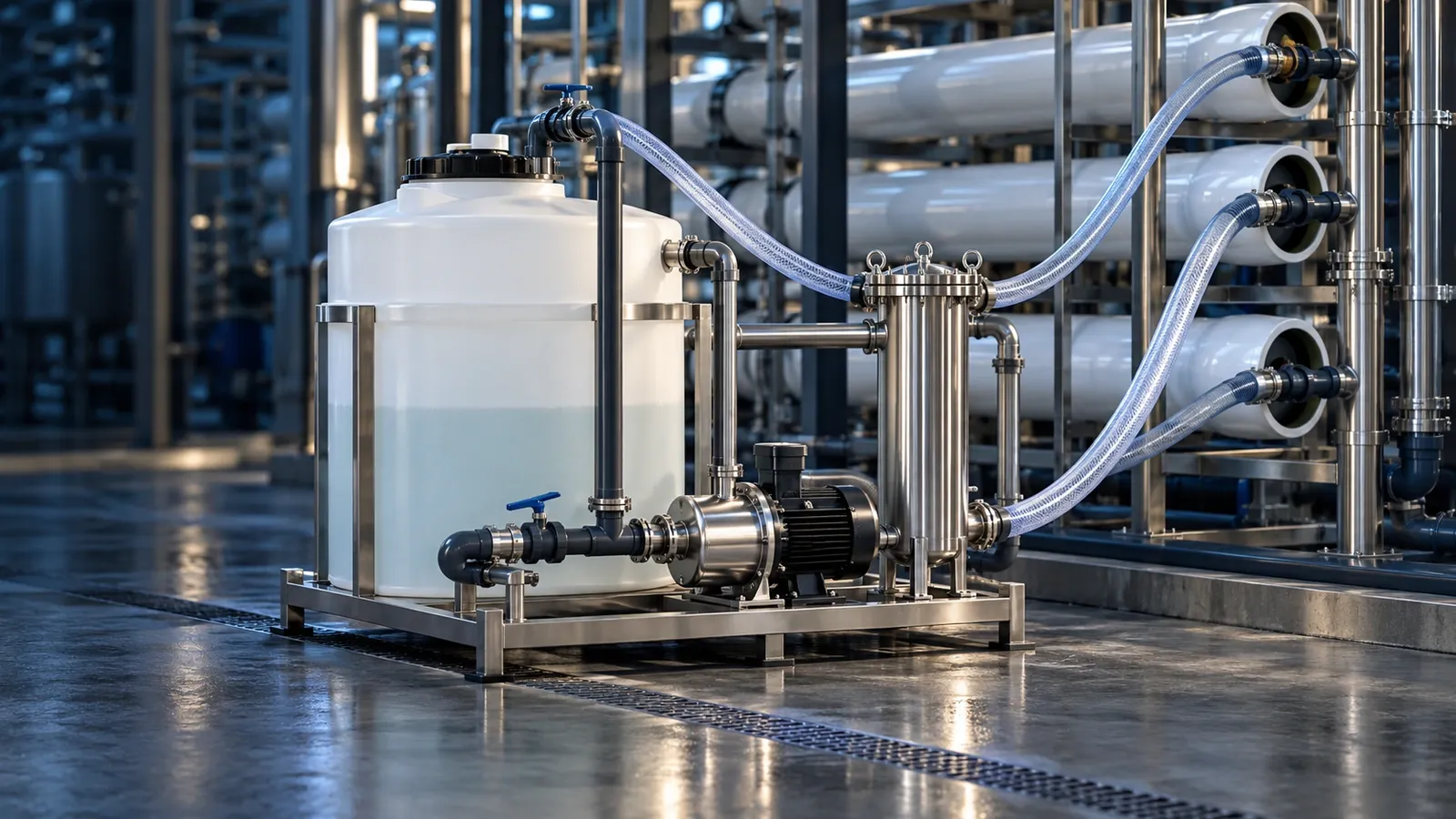
- A tank, pump and cartridge filter set up for cleaning, with the chemical made up in clean water of suitable quality.
- Control of temperature and pH during the clean, within the limits stated for the membrane and the cleaner.
- Alternating recirculation and soak, rather than recirculation alone, so the chemical has time to act on the deposit.
- A thorough flush before returning to service, and a record of the normalised data after the clean.
Treatment rates and contact conditions are set from the deposit, the membrane type and the membrane supplier limits for that membrane, and our technical team can discuss them against your water analysis and operating conditions.
What if performance does not recover after a clean?
If normalised flow and differential pressure return only partly, the likely explanations are an incomplete clean, a deposit that needs the other type of cleaner, or irreversible damage. Repeating the same clean rarely improves matters. Go back to diagnosis: review the feed analysis, the pre-treatment performance and the foulant evidence, then change the approach.
If the problem returns quickly after every clean, the root cause is still active upstream. Cleaning is a corrective step, and prevention through pre-treatment, antiscalant selection and biological control is what extends the interval between cleans.
How do I judge whether the clean worked?
Compare the normalised data after the clean with the data before it and with the commissioning baseline. A good result shows differential pressure falling back towards the baseline, permeate flow recovering and salt passage settling. A partial result is information too: it tells you which deposit was removed and which is still there.
- Differential pressure returns close to the baseline on every stage that was cleaned.
- Normalised permeate flow recovers, even if not completely.
- Salt passage does not rise after the clean, which would suggest surface damage from the cleaning conditions.
- The result lasts: performance does not drift away again within a short time.
Can chemical cleaning be reduced over time?
Yes, when the cause of fouling is addressed upstream. Stable pre-treatment, a suitable antiscalant fed reliably, control of biological growth and sensible shutdown practice all lengthen the interval between cleans. Each avoided clean saves chemical, water, downtime and stress on the membrane, so the effort put into prevention usually pays back.
What should I send for a technical review?
- Trend data for normalised permeate flow, salt passage and stage differential pressure since commissioning.
- A recent feed water analysis and the pre-treatment configuration.
- The membrane type and configuration, and the recovery and operating basis of the system.
- The antiscalant and any other chemicals currently fed, and how they are metered.
- The date and method of the last clean, and the result that followed it.
Next step
Send your operating data and a recent water analysis to our technical team for a technical review.
Sources
- Advanced Chemicals Industrial product datasheets, for the product categories and monitoring practice they state.
- General industrial water-treatment practice, described qualitatively.
Let's discuss your water system.
Share the application and operating context to start a technical review.